
 I grew up reading Fantasy books through the 1960s and 1970s. It was in the early 1970s when all Fantasy readers *had* to read The Lord of the Rings by JRR Tolkien, though the stories had been written four decades earlier.
Thus began a new awareness of trilogies, though some had existed before. During that era, rather a lot of authors wrote Fantasy stories in trilogy form. Very few broke out into longer series. The first of these I read was The Death Gate Cycle by Tracy Hickman and Margaret Weis. There were (and still are) seven books to the series. I was exhausted with the world by the time I had finished them all, yet I had to finish and see what happened to Haplo, the main character.
That was long before indie publishing and the never-ending series we see in the Romance genre. For Fantasy, it was unusual at the time. Since then, we’ve had other series that go on for many volumes. The Wheel of Time series by Robert Jordan, which eventually reached fourteen volumes, and the very well known A Song of Ice and Fire series by George R.R. Martin that is intended to continue for seven volumes, if he ever finishes writing the last two.
The trouble is, a series that long effectively holds the reader hostage. Even some of the longer series of those early days of Fantasy fiction tended to break up into grouping of three to five books.
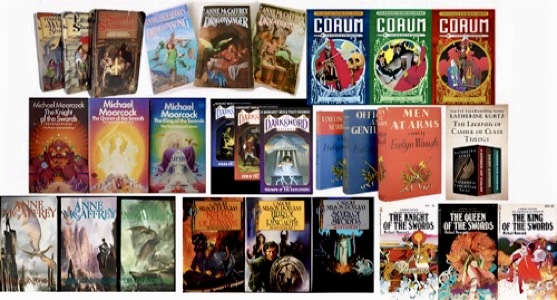
Yet some authors like Michael Moorcock and Anne McCaffrey worked out that an imaginary world could have more than one trilogy. Their words could expand indefinitely through digestible increments and readers could indulge in other series between the trilogies of the various worlds they loved.
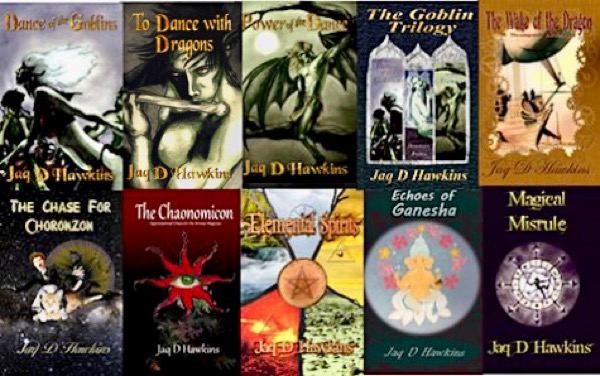
This is an idea I’ve contemplated over time. My Goblin Trilogy explores a world I really like to write in, but the series arc comes to a tidy finish and doesn’t call for further sequels.
 On the other hand, working on related short stories for the series has brought my attention to the possibility of writing other books in the world, but perhaps in other times and places of the planet’s history. Exploring it through new characters has a certain appeal.
My current WIP is a stand alone story, yet somehow the goblins managed to creep in, if only for one chapter. It wasn’t planned. There I was crossing an inhospitable mountain range where dragons pose a serious threat, with an Alchemist on the run from a small kingdom’s ruler, and a goblin I recognised stepped into the story at a crucial point. Goblins are long lived, so it came to my attention that this world I had been creating was a different territory of the world I had created before!
The goblins won’t play a major role in the story or any sequels that might follow, but their relationship with dragons shaped that particular scene. It all fit a little too neatly.
When I look back at the Fantasy stories I grew up on, I can see how frequently this method of expanding an imaginary world has been used by some of the best authors of the genre. Roger Zelazny wrote his Chronicles of Amber in two five book series. Michael Moorcock wrote his Eternal Champion series through multiple trilogies and many incarnations of the main character who went by different names, but somehow were all part of the same universe. Anne McCaffrey’s Pern series started out with first one trilogy, then a second one and expanded from there.
Personally, I find it easier to read a long series in expanded bits, rather than following a twenty-four volume sequential series. Do you agree? Let’s chat in the comments.
Jaq D Hawkins
Books available at:
Amazon:
 Chris The Story Reading Ape's Blog
A lot of good series mentioned here.
LikeLiked by 2 people
Yes, I went for the old classics of the genre as people who read Fantasy would recognise them.
LikeLiked by 1 person
Good decision. 😉
LikeLike
I love all the series you mentioned, Jaq. A pity you couldn’t get on with Anne McCaffrey books. I loved them. And Dragonlance.
My first fantasy book was based on a D&D scenario I wrote for my D&D club, as was Dragonlance, of course. It was supposed to be a standalone, but it has morphed into what will be at least 5 books. Three are published, the fourth in the critique process, and the fifth developing in my head. The series has changed a lot in the writing!
I have written three prequels with another just sent to the publisher last Friday, and have ideas for ones set in other times.
I think it’s great fun writing in the same world.
LikeLiked by 2 people
loved the first two Pern trilogies, it was just when it got too much into computer intelligence and away from dragon action that I lost interest.
LikeLiked by 1 person
I really enjoyed this! I, too, wondered at the endless series of fantasy. I prefer trilogies if I have to write longer books for the story. I do set some of my short stories in the same world though and have thought of expanding the world with other characters and their stories.
LikeLiked by 2 people
I have a short story collection for my goblin world in progress.
It fills in some history and allows me and any interested readers to go back to that world again.
LikeLiked by 1 person
What is your genre Audrey? I can see this working in various genres, though Fantasy really calls for it.
LikeLiked by 1 person
The aforementionend White/Hickmann wrote the Dragonlance series – in installments of several trilogies. Read the first and was enthralled. Read the second – and a little bit less enchanted. Never made it further.
On the other hand – the Anne McCaffrey Pern-series was lovely to read. Two trilogies and several other standalone novels. Loved that. (Not strictly fantasy, neither strictly SF, but mainly fantasy with a few SF elements)
LikeLiked by 2 people
My daughter loved Dragonlance. I tried a couple of the books and didn’t really get into it, though I understand some are better than others. I may try again someday.
LikeLiked by 2 people
Only the first three are really great – but maybe you need to be a RPGer … because that is where that story started out: the Chronicles of the adventures of a group of role players. Epic campaign. And RPGers can still detect it.
LikeLiked by 1 person
That explains it. She’s more nerd than I am, even does LARP.
LikeLiked by 1 person
Totally agree with you, Jaq. I grew up in the 70s, reading lots of trilogies. When I published my first book, an epic fantasy, I planned it to be the first part of a trilogy. It ended up at 4 books (thank goodness for self publishing, I really couldn’t have crammed that much story into 3), and that was a natural end for that group of characters.
Now I’m writing an origin story for one of those characters, and planning a new trilogy for the next generation, with yet another trilogy set after that to round off an overall very long arc. I’m waiting to see if it stays at trilogies this time!
LikeLiked by 3 people
Ironically, my Goblin Trilogy started out as a stand alone, but around halfway through I started seeing things that needed to happen in the next generations. So it turned into a Trilogy organically.
LikeLiked by 2 people
That’s the way of good stories 😁
LikeLiked by 2 people
I can relate to this, Jaq, even though my books aren’t fantasy. My main series would have been a trilogy, except the middle book was too long, so I chopped it in two, creating something I call a “series,” because “tetralogy” is awkward. I thought I finished it with the last book, but couldn’t resist a kind of sequel consisting of two more books. The main character of those is related to characters in the 4-book series.
I do agree that shorter linked sets of books are better for readers than an endless series.
LikeLiked by 2 people