

When writing a novel, it is important for us, as authors, to know our characters well. We need to know much more about them than we directly reveal to our readers. With that background knowledge of them, their makeup, their likes and dislikes, we hope that our readers will deduce a lot about them from how we make them behave in the story we weave.
We need to know whether the hero would have a soft centre. If he is an all action, gun-toting, rough and ready cowboy, it might be terribly out of character for him to fondle the cat, or cuddle the kitten. Then again, it might not be. If we don’t know that about him before we write his story, how can we portray him with understanding and make him so real our readers will feel they know him too.
There are many factors we can consider, many situations we can imagine, many features we can study that will help us bring our characters to life. In this short series of articles, I take a fairly light-hearted look at just one of them. Food.
I don’t intend to become too scholarly about it, so, if you’re looking for in-depth analysis of the part food plays in fiction, I’m afraid you’ll have to look elsewhere. However, I do aim to share some interesting thoughts and examples with you, and hopefully get you thinking about how food is used in classical and popular literature, how I use it in my writing, and how you might use it in your own writing.
In the term Food, for this purpose, I include food, drink, snacks and sweets. Anything that characters may or may not consume for pleasure or sustenance.
Food plays such an important part in everyone’s life, whether happily or unhappily, that understanding the part it plays is fundamental to knowing a person well.
Think about your family and close friends. No doubt you would know what to cook for them, and what not to cook.
You’d know that Auntie Jeanie doesn’t like cabbage; it gives her flatulence. Uncle Herbert likes his beer at room temperature while he watches the sports channel.
Have you already formed a picture of how Auntie Jeanie and Uncle Herbert might look? What their domestic arrangements might be? What if I added that Auntie Jeannie always puts Uncle Herbert’s beer in the fridge? Have you a scene already playing in your mind? Does she do it to irritate him? Or is she just forgetful? What if I tell you she smiles as she does it? Getting a clearer picture now?
You don’t have to tell your reader that Jeannie gets wind when she eats cabbage. You might just show her declining it at table with a bit of a grimace and her hand fluttering to her chest. Or she might come right out with it regardless of the company, “No thanks, best not. Not if you don’t want me farting all night.”
Can you see two very different portrayals of Auntie Jeanie there?
Even if you don’t choose to include scenes where food is mentioned in your story, it is helpful if you think about how your characters feel about it, just so that you know them better right from the start. Let’s face it, they’re going to be keeping you company for a considerable amount of time, especially if it’s a blockbuster novel you’re writing.
One of the questions you, as an author, might ask about your characters is what kind of food they like to eat or to cook. Perhaps they are a ‘Foodie,’ cooking up great culinary delights to please their family or guests who dine at their table. Perhaps they are too busy to cook but love to eat good food and dine out regularly, or perhaps they throw together some weird concoctions just to satisfy their hunger pangs, with no sense of pleasure in preparing or eating their sustenance. At one end of the spectrum, you might be writing about a poor damaged soul, with no happy memories of delightful family mealtimes, at the other, a well-adjusted, happy individual who spends much time, energy and money on producing and delighting in delicious food.
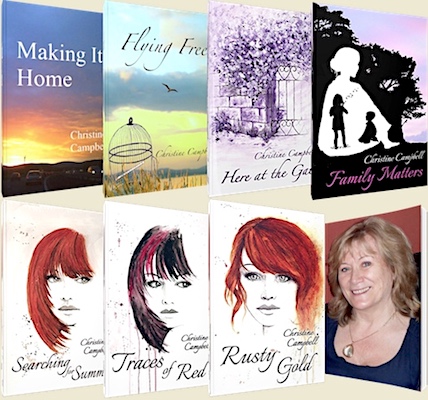
In my own writing, in the Reluctant Detective Series, the main character, Mirabelle, is one of those people who are obsessed with food, but rarely if ever cooks. Her idea of dinner when home alone is ‘leftover pasta from the night before with a dried up chunk of pizza, the dregs of a pot of potato salad and half a tin of cold baked beans. Too hungry and too tired to bother heating anything, she settled in front of the TV to eat it…’
However, she loves when confronted with this scenario:
‘Sometimes, when Mirabelle puffed and panted up the stairs, realising she’d forgotten to shop, trying to remember what bits and pieces of this or that or leftovers there might be in the fridge, her heart would lift at the sound and smell of cooking as she opened the door. Chicken and Garlic. Beef Hot-pot. Fish Pie. Home-cooked, hot food. Money found, shopping accomplished, preparation done, cooking in progress. The table would be set, knives and forks neatly aligned, plates warmed and ready.
What a star!’
Her daughter Summer was so unlike her. Summer loved to cook, and, when she goes missing, Mirabelle’s eating habits become worse than ever.
In this series, food is one of the things I have used to help ‘flesh out’ my main character. (Pun intended :-)) It gives Mirabelle some ‘substance’. (Pun apologised for :-))
From anorexia to obesity, the relationship your character has with food can reveal a lot about them and their history. You may not choose to discuss it much in your novel or short story, but knowing what that relationship is can go a long way in helping you and your reader get to know your character.
Amazon:
 Chris The Story Reading Ape's Blog
Reblogged this on cicampbellblog and commented:
When Chris, The Story Reading Ape, sent out the invitation for writers to guest on his blog, I felt it was too good an opportunity to miss. Chris is so supportive of other writers and bloggers, and so well loved and respected by them, it is a great honour to be featured by him, and one I am very grateful for.
The invitation was to write four family-friendly articles, so I have chosen to write about the role food plays in fiction. I mean – what could be more family-friendly than food?
LikeLiked by 1 person
Agreed. I use food to demonstrate the epicurean and refined nature of my secondary character. Also, coming up with names to reflect the name of a familiar food in a fantasy world is always a bit of fun.
LikeLiked by 2 people
Yes, I can imagine that being a lot of fun, Ernesto.
Thank you for commenting.
LikeLiked by 1 person
Reblogged this on Matthews' Blog.
LikeLiked by 2 people
Thanks Matthew 👍😃
LikeLiked by 2 people
Thanks, Metthew.
LikeLiked by 2 people
Reblogged this on Don Massenzio's Blog.
LikeLiked by 2 people
Thanks Don 👍😃
LikeLiked by 1 person
Thanks, Don.
LikeLiked by 2 people
You’re welcome
LikeLiked by 1 person
Thanks, Christine, and Chris, for this helpful information. 🙂 — Suzanne
LikeLiked by 2 people
Very welcome Suzanne 😃
LikeLiked by 2 people
Thank you, Suzanne. Glad you find it helpful.
LikeLiked by 1 person
I love seeing food in fiction. Making up alien vegetables in my SciFi can be difficult, but I take my inspiration from Deep Space 9 when necessary. I sometimes think adding the recipes at the back would be fun 🙂
LikeLiked by 2 people
Oh, yes, that would be great fun. You could be really creative in SciFi, couldn’t you?
LikeLiked by 2 people
Reblogged this on TINA FRISCO and commented:
Christine Campbell discusses our fictional characters and their relationship to food. See her guest post on The Story Reading Ape …
LikeLiked by 2 people
Many Thanks for sharing Tina 😀 XXX
LikeLiked by 2 people
Thanks, Tina.
LikeLiked by 2 people
Reblogged this on Smorgasbord – Variety is the spice of life and commented:
Christine Campbell begins a series on food in our writing and how it can fill out our characters (pun intended) over on The Story Reading Ape…today. Head over and add you ingredient!
LikeLiked by 2 people
Many Thanks for sharing Sally 😀 XXX
LikeLiked by 1 person
Thanks, Sally.
LikeLiked by 1 person
love what you wrote, I actually never thought about this, I didn’t think that food can show the character preference or a small part of it’s personality.
LikeLiked by 2 people
I’m delighted this was a new thought for you, Thourya. Hope it helps you develop your characters in your own writing.
Thank you for commenting.
LikeLiked by 2 people