
Zoe and The Bard
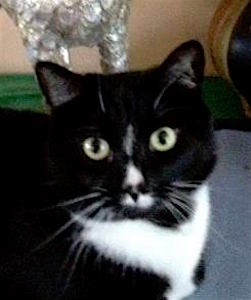 Knock, knock . . . who’s there? ‘Tis I, Zoe the Fabulous Feline, and I thought that today I would open my story with that timeless joke. But alas! It loses something if the one being pranked is not available to answer in the flesh, so I guess I will just go on with my story instead. And speaking of flesh, this story is the naked truth and one I think you will enjoy.
Because, after all, you are here today because you are either a writer or a reader; either way you are a lover–a lover of words. Guess what? Me too! I may be a cat, but I am fabulous. Fabulous. Now there is a word I love; can you tell? My human named me Zoe, but I added “the Fabulous Feline.” Why? Well, because—in addition to the obvious—I love alliteration. I love words! That’s why. And I’m here today to call your attention to the joy of language. Now, why does that sound so familiar? Hmmm, let me think. Oh, I know! I saw this book on my human’s night table once, and it was entitled . . . well, never mind. The title is neither here nor there. But just remember, there is nothing either good or bad, but thinking makes it so; suffice it to say that the book’s title sounded similar to what I just wrote a minute ago and what I need to get back to: the joy of language. So, for goodness sake, enough of this rant. I will bring an end to this wild goose chase. I am sure you wait with bated breath for me to go on. And so, dear friends, I will. Today’s story is all about The Bard.
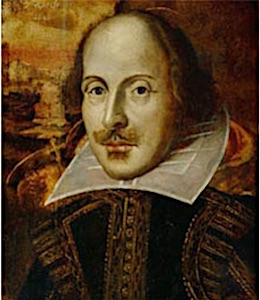
I know what you’re thinking—finally, Zoe gets to it. Finally she comes full circle to the purpose of today’s story, which is The Bard. The Bard of which I speak is, of course, the incomparable, 16th century, England-born poet and playwright, William Shakespeare. (Or “Billy Shakespeare” as my canine comrade Danny the Dog calls him.) And I invite all of you, lover of words that you are, to put your hand over your heart, to turn your eyes skyward, and to think of Mr. Shakespeare with a fond, albeit belated, Happy 452nd Birthday!
I say belated birthday because, had I been on top of my game, I’d have written this story for last month’s column, at which time we could have wished him a happy birthday a bit before his special day, April 23rd, instead of a month later. Having said that, I must admit that, while it is a fact that he was born in 1564, nobody knows with absolute certainty what date Shakespeare was born, but scholars consider his birthday to be April 23rd. However, there exists no record of his birth, so how did they choose that date? Did they pull it out of their a—I mean . . . the air?
Nope, they surely did not. Here is the back-story and a little factoid for you. It is a matter of public record that William Shakespeare was baptized on April 26, 1564. In those days, babies were almost always baptized three days after their birth. Voila! His birthdate is presumed to be April 23rd. And to add a little ironic poetry to this prose, it is also a matter of public record that he died on April 23rd, in 1616, at a ripe old (in those days) age of fifty-two years.
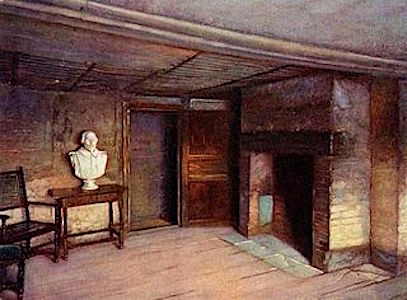
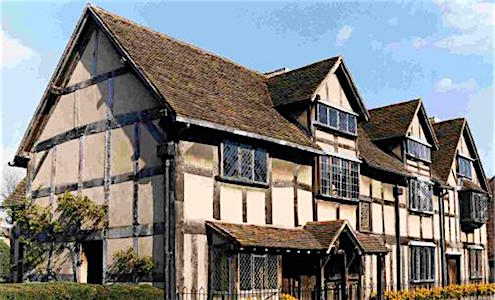
Shakespeare was born to an ordinary family and lived his entire, relatively ordinary life where he was born, on Henley Street in Stratford-upon-Avon in the United Kingdom. Like many greats, Shakespeare gained his fame posthumously, becoming after his death the world’s most-read playwright—creator of the most-performed plays—in the world. Which leads me to this thought:
We know what we are, but know not what we may be.
And that thought is a quote from The Bard, as are all the italicized phrases in my story, which came from some of Shakespeare’s great works, such as Othello, Hamlet, MacBeth, Love’s Labour Lost, The Merchant of Venice, King Lear, Henry VIII, and—speaking of lovers—the tragic Romeo and Juliet. Oh, and let’s not forget Some Like It Hot. OK, OK, so that last one was just a test. (Not really, but as a Fabulous Feline, I have to try to pull a fast one or at least be humorous, right?)
These are but a few of the many Shakespearean phrases commonly used in our modern vernacular. And this is why we all are actually far more sophisticated than we might have thought. We quote one of the greatest wordsmiths ever. And probably on a daily basis. How cool is that?!
Ciao, baby! OK, that is not Shakespeare. (I think it was Telly Savalas who made that famous.)
But this is Shakespeare and it seems a fitting end to this little bit of literary history:
“Words are easy, like the wind;
Faithful friends are hard to find.”
 Chris The Story Reading Ape's Blog
I would never have thought a cat can be this poetic, Zoe. But then, I should have known you could You are fabulous after all! Well done. There’s poetry in every word!
LikeLiked by 1 person
Once again, you’ve outdone yourself, my fabulous furry friend. Ciao for now, meticulous meow 🙂
LikeLiked by 2 people
Thank you, Miss Tina….good to see you out and about again, even if only briefly!
LikeLiked by 2 people
And thank you, Ms. Zoe. The book seems to be writing itself, so I expect to have my head above water within a month or so 🙂
LikeLiked by 1 person
Yikes! If this was the 1400’s I would only have a couple of years left to get my Magnum opus finished!
LikeLiked by 1 person
Thankfully, then, we find something good about the 21st century!! Thanks for reading, Joseph. I hope I’ve made a new fan!
LikeLiked by 2 people
Yes indeed. In spite of all our complaints about the health care systems we are no longer dying in our thirties from scurvy or small pox.
LikeLiked by 1 person