
If you enjoyed this article, why not share it with all your friends, online connections and groups - GO ON - you KNOW you WANT to!
- Share on Bluesky (Opens in new window) Bluesky
- Share on X (Opens in new window) X
- Share on Facebook (Opens in new window) Facebook
- Share on Tumblr (Opens in new window) Tumblr
- Share on LinkedIn (Opens in new window) LinkedIn
- Share on Flipboard (Opens in new window) Flipboard
- Share on Pinterest (Opens in new window) Pinterest
- Share on MIX (Opens in new window) MIX
- More
 Chris The Story Reading Ape's Blog
Basically take an English derived Latin word and change in an English Saxon barbarian one… I’m happy you still recognise us, your past Latin masters, as rational while Saxon as emotional (just barbarians).
LikeLike
Reblogged this on Writer's Treasure Chest and commented:
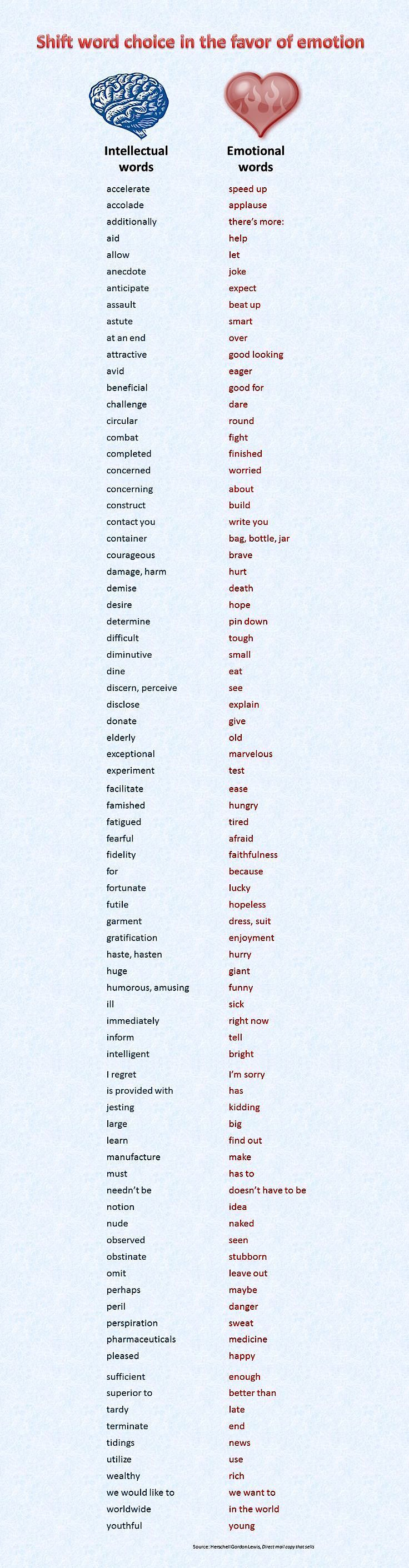
Why not shifting our word choice in favor of emotion? The Story Reading Ape knows why and has delivered a helpful infographic.
LikeLiked by 1 person
This is cool, educational and helpful!! Thank you for sharing, Chris!!
LikeLiked by 1 person
Welcome Aurora 😀
LikeLiked by 1 person
Great infograph, Chris. Thanks for sharing. 🙂 — Suzanne J.
LikeLiked by 1 person
I agree with the inforgraphic. When using the intellectual word vs the emotional word, the intellectual usually sounds stitlted.
LikeLiked by 1 person
Interesting to note that many of the intellectual words derive from Latin while the emotional words have Germanic origins. Just a couple of examples: fortunate (from L. fortunatus) and lucky (from Dutch, cognate with German gluck). Also manufacture (from late Latin manufact, to make by hand) and make (ultimately related to German machen)
I agree with Mobiuswolf that the words have differing connotations and you just have to pick the word that best fits your purpose in all instances. Actually, my termite characters speak a quite formal diction with lots of intellectual words. Does that surprise you?
LikeLiked by 1 person
I had noticed Lorinda, but being a retired Engineer, I’m more used to formal / intellectual wording, so it actually enhanced my reading experience of your Termite series 👍😃
LikeLiked by 1 person
Reblogged this on Anita Dawes & Jaye Marie.
LikeLiked by 1 person
funny = humorous, amusing, uproarious, droll, titillating, riotous, whimsical, facetious, waggish, witty, jocular
LikeLiked by 1 person
I’m not buying that. Many of those don’t even mean the same thing and many more have a fuller, more nuanced meaning. Dumbing down your language, in many of those instances, actually portrays less emotion.
They do have fewer letters, mostly. :o)
LikeLiked by 2 people
I agree – for example take anecdote and joke – one is a story about something you have experienced (not necessarily funny) – and a joke is a joke, something with a punchline, something designed to make you laugh – often with hyperbole.
In the debate between statistics and your own observances, it is anecdotes, not jokes that do not trump scientific studies.
LikeLiked by 2 people