
Some writing tips from Savvy Business Correspondence HERE

If you enjoyed this article, why not share it with all your friends, online connections and groups - GO ON - you KNOW you WANT to!
- Share on Bluesky (Opens in new window) Bluesky
- Share on X (Opens in new window) X
- Share on Facebook (Opens in new window) Facebook
- Share on Tumblr (Opens in new window) Tumblr
- Share on LinkedIn (Opens in new window) LinkedIn
- Share on Flipboard (Opens in new window) Flipboard
- Share on Pinterest (Opens in new window) Pinterest
- Share on MIX (Opens in new window) MIX
- More
 Chris The Story Reading Ape's Blog
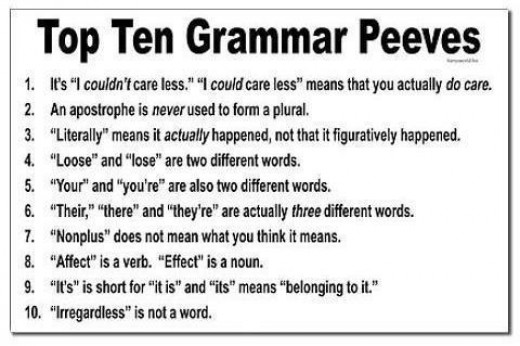
Sorry but according to the Oxford English Dictionary ‘irregardless’ not only is a word it has been in use for over a hundred years. However it is rarely used correctly and is considered non standard English.
LikeLiked by 1 person
There are two issues in the above table, American English ie could care less, and English, plus grammar, the rest of the points.
LikeLike
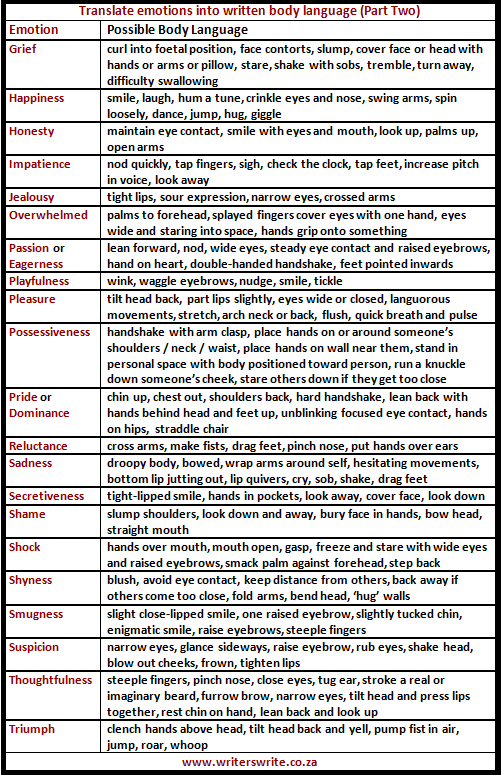
I got a kick out of the body language table. Thanks. To be fair, though, ‘affect’ can be a noun and ‘effect’ can be a verb—which is perhaps why so many people tend to get them mixed up.
LikeLike
Thanks for that Laura 😀
LikeLike
Reblogged this on theowlladyblog.
LikeLike
😀
LikeLike
I agree with the top ten errors except one. “Effect” can be a verb, as in “to effect a change.” Here what Dictionary.com says:
verb (used with object)
10. to produce as an effect; bring about; accomplish; make happen: The new machines finally effected the transition to computerized accounting last spring.
And “affect” can be a noun – a psychological term for a feeling or emotion.
LikeLike
Thanks for the clarification Lorinda 😀
LikeLike
Reblogged this on Author P.S. Bartlett and commented:
Sharing the good stuff! Thank you for sharing this Chris!
LikeLike
Thanks PS 😀
LikeLike
Reblogged this on Have We Had Help? and commented:
Things that can and do confuse…
LikeLike
Thanks Jack 😀
LikeLike
My pleasure 🙂
LikeLike
Those grammar corrections reminds me of the days when I used to teach English at high school. The list of frequent mistakes was much longer and my aim was always to make them aware of what they were writing so that they would self correct.
LikeLike
😀
LikeLike
These are excellent, Chris. One of my pet peeves is when people say, ‘i could care less’ argh!
LikeLike
😀
LikeLike
Chris – thanks! I can’t tell you how many times I’ve heard even Ivy League types say: I could care less! They would not listen to me correcting them either — because I am Indian and their egos would not permit them to believe I could know better English…great tips as usual!
LikeLiked by 2 people
While working in the Middle East, english speaking Indians I met all spoke better (and more correct) english than most British people.
The only problem I had sometimes was that they spoke it faster than my ears and brain could follow it – this is because I have tinnitus that masks certain pitches in speech.
😀
LikeLike
Yes, Indians speak rapidly…and swallow a lot of their words as well…not to mention the range of accents! Which makes even good English hard to follow. However there is a large segment of the Indian pop that has excellent English. My parents loved the language, fortunately, and insisted we spoke it at home. Unfortunately I did not get to learn Indian languages!
LikeLike
😀 😀 😀
LikeLike