
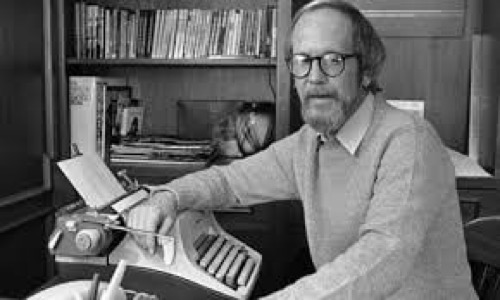
 Elmore Leonard was an American writer who wrote nearly fifty novels, twenty-six of which were made into movies with stars such as Paul Newman, John Travolta, and Russell Crowe.
He was awarded the Edgar Award for Best Mystery Novel, the F. Scott Fitzgerald Literary Award for outstanding achievement in American literature, a Peabody, the Grand Master Award for Lifetime Achievement from the Mystery Writers of America, and the National Book Award. The guy was some kind of impressive. He was also one hell of a writer.
I read everything he wrote, a lot of it twice.
These are rules I’ve picked up along the way to help me remain invisible when I’m writing a book, to help me show rather than tell what’s taking place in the story.
If you have a facility for language and imagery and the sound of your voice pleases you, invisibility is not what you are after, and you can skip the rules.
Still, you might look them over.
Onto the rules.
1. Never open a book with weather:
If it’s only to create atmosphere, and not a character’s reaction to the weather, you don’t want to go on too long. The reader is apt to leaf ahead looking for people.
2. Avoid prologues:
They can be annoying, especially a prologue following an introduction that comes after a foreword.
3. Never use a verb other than “said” to carry dialogue:
The line of dialogue belongs to the character; the verb is the writer sticking his nose in. But said is far less intrusive than grumbled, gasped, cautioned, lied.
4. Never use an adverb to modify the verb “said”:
… he admonished gravely. To use an adverb this way (or almost any way) is a mortal sin. The writer is now exposing himself in earnest, using a word that distracts and can interrupt the rhythm of the exchange.
5. Keep your exclamation points under control:
You are allowed no more than two or three per 100,000 words of prose.
6. Never use the words “suddenly” or “all hell broke loose”:
This rule doesn’t require an explanation. I have noticed that writers who use “suddenly” tend to exercise less control in the application of exclamation points.
7. Use regional dialect, patois, sparingly:
Once you start spelling words in dialogue phonetically and loading the page with apostrophes, you won’t be able to stop.
8. Avoid detailed descriptions of characters:
In Ernest Hemingway’s “Hills Like White Elephants” what do the “American and the girl with him” look like? “She had taken off her hat and put it on the table.” That’s the only reference to a physical description in the story, and yet we see the couple and know them by their tones of voice, with not one adverb in sight.
9. Don’t go into great detail describing places and things:
You don’t want descriptions that bring the action, the flow of the story, to a standstill.
10. Try to leave out the part that readers tend to skip.
The most important rule is one that sums up the 10: If it sounds like writing, rewrite it.
 Chris The Story Reading Ape's Blog
Longtime Leonard fan. You know, I bought a hardbound book of the rules several years ago. How’s that for a waste of money. I agree with Dutch about “said.” Ideally, you want to even leave the “he/she said” part off as well. If you look back at Leonard’s stuff, you’ll see that he did just that.
LikeLiked by 1 person
Love this and it’s very useful. Thank you.
LikeLiked by 2 people
You’re welcome, Katie 😃
LikeLike
I found it useful. too.
LikeLiked by 1 person
Good advice.
A couple of things, though: People like different things, and that’s a problem. In my critique group, I get people who say they would like more description, of the surroundings, and of the characters, to help them imagine the scene. Others want less.
And I know we are told to use ‘said’, but never told anything more. Personally, I find a dialogue with ‘he said’, ‘she said’, ‘Jack said’, all the time becomes boring and repetitive.
eg. ‘I’m going shopping,’ Jane said. ‘I need a new jumper.’
‘I’ll come with you,’ Jack said. ‘I can look for a shirt at the same time.’
‘Should I drive?’ Jane said.
‘If you like,’Jack said. ‘I know you’re anxious to drive the new car.’
Boring!
Rarely, with this advice, have I seen how to resolve this. Very few posts say to leave the dialogue tag out a few times if it’s only two people speaking. Or to use an action beat instead.
The description problem can’t be resolved, though. You can’t please everyone.
LikeLiked by 1 person
I used to have the same problem and struggled with how to remedy it. What I’ve found is that if there’s a short burst of dialogue between just two people and you’ve initially said, ‘Jack said’, then it’s clear going forward who is speaking (especially as the next piece of dialogue is on a fresh line). It also makes it flow and become more fluid. Then, if it becomes unclear again as to who is speaking, you can add in another, ‘Bethany said etc.’. Don’t know if that helps. Nb I have problems with adverbs!
LikeLiked by 3 people
I agree with you two guys.
LikeLiked by 2 people