
About the medieval tannery
The City of Caves in Nottingham comprises of a network of caves, carved out of sandstone, that have been put to various uses of the years including as a medieval tannery, public house cellars and, during World War II, as an air raid shelter.
Two of the caves in this intricate network historically housed the only underground tannery in Britain. The Pillar Cave was originally cut in approximately 1250 AD, but had been filled in as a result of a rock fall by 1400 AD. In 1500 AD it was cleared and reopened as part of a tannery. Circular pits were cut into the floor to hold barrels. A second cave was also cut with rectangular clay-lined vats. The smaller size of these vats indicate that they were probably used for tanning sheep or goats skins rather than cowhides.
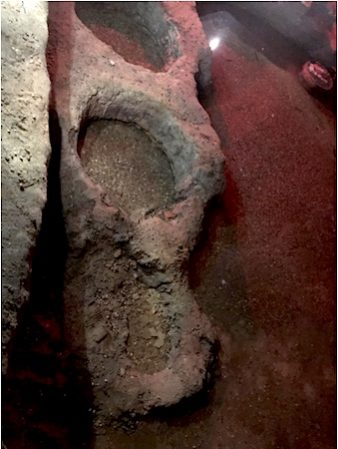
Picture of the circular pits cut into the caves used as a medieval tannery by Robbie Cheadle
The medieval tanning process
Tanning, in medieval times, was a dirty and smelly process so tanneries were located away from towns and villages. Tanners sourced the hides from butchers, who delivered them with the horns and hooves still intact and stiff with dried gore, dung and dirt. The tanner removed the horns and hooves and then soaked the skins in water to clean and soften them. The medieval tannery in the Nottinghill Caves had an opening out to the River Leen in order to facilitate this washing process. This river also provided the town’s drinking water.
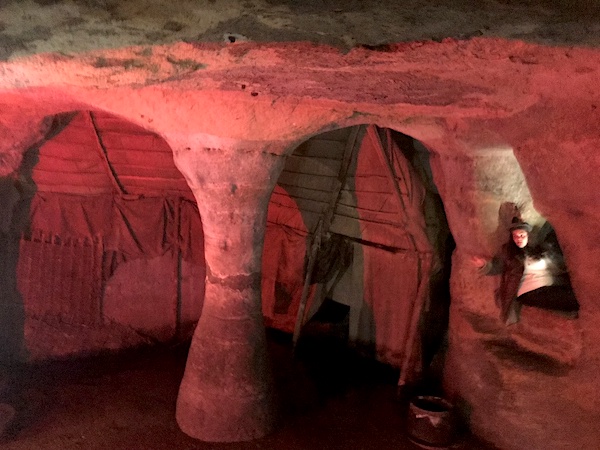 Picture of the medieval tannery during our tour of the Nottingham City of Caves by Robbie Cheadle
Once the hides were clean, the tanner would pound and scour the skin to remove any remaining flesh and fat from it. Next came the process of removing the hair from the skin. This was done in one of the following three ways: soaking the skin in urine, soaking it in an alkaline lime mixture or leaving it to putrefy for several months and then dipping in into a salt solution. Once the hairs had been loosened through one of these processes, the tanner would scrape them off with a knife.
The cleaned hide would then soften (“bate”) the skin by pounding dung into it or soaking it in a solution of animal brains. Bating was a fermentative process which relied on enzymes produced by bacterial found in the dung. Dog or pigeon dung was the most commonly used by tanners at this time. The bating process would take up to three months.
The hides were washed again in water and then the tanner preserved them with a solution made from the bark of an oak, spruce fir or any other tree that was available. The first phase of the preservation was done in a weak solution with the hides being taken in and out of this solution until the attained the desired colour. The second phase involved the tanner placing the hides in a deeper pit and layering them with bark. Cold water or a weak tanning solution was poured over them and then they were left for approximately a year. The tanning process was then complete and the tanner would sell the hides to another craftsman to turn into shoes or other needed products.
About Robbie Eaton Cheadle
 I am an author who has recently branched into adult horror and supernatural writing and, in order to clearly differential my children’s books from my young adult and adult writing, these will be published under the name Roberta Eaton Cheadle. My first young adult supernatural novel, Through the Nethergate, has recently been published.
I have two short stories in the horror/supernatural genre included in Dark Visions, a collection of 34 short stories by 27 different authors and edited by award winning author, Dan Alatorre as well as three short stories published in Death Among Us, a collection of murder mystery short stories by 10 different authors and edited by Stephen Bentley. These short stories are published under Robbie Cheadle.
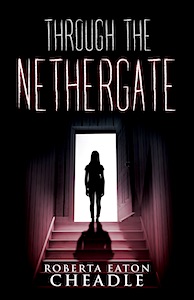
Through the Nethergate
Margaret, a girl born with second sight, has the unique ability to bring ghosts trapped between Heaven and Hell back to life. When her parents die suddenly, she goes to live with her beloved grandfather, but the cellar of her grandfather’s ancient inn is haunted by an evil spirit of its own.
In the town of Bungay, a black dog wanders the streets, enslaving the ghosts of those who have died unnatural deaths. When Margaret arrives, these phantoms congregate at the inn, hoping she can free them from the clutches of Hugh Bigod, the 12th century ghost who has drawn them away from Heaven’s White Light in his canine guise.
With the help of her grandfather and the spirits she has befriended, Margaret sets out to defeat Hugh Bigod, only to discover he wants to use her for his own ends – to take over Hell itself.
A clever melding of fiction and historical facts.
Blog – Twitter – Goodreads – Google+
Facebook – FB Sir Chocolate Books
Amazon:
 Chris The Story Reading Ape's Blog
Thanks for another fascinating history lesson, Robbie! 🙂
LikeLiked by 2 people
I am glad you enjoyed this, Bette.
LikeLiked by 1 person
This is fascinating, Robbie. I love caves, and ever since I began my current WIP, I’ve been interested in anything from the Medieval period. I love that these caves were put to good use, but I wonder if tanning skins in an enclosed area was safe for the workers.
LikeLiked by 2 people
Thanks for reading, Vashti. It wasn’t safe work at all. The concentrated lime and urine burned their skin and eyes. Of course, they also got sick and died from polluted water and other horrible diseases.
LikeLiked by 2 people
That’s terrible. 😦 Thanks for the information, though.
LikeLiked by 2 people
I don’t imagine that kind of work was easy on the back or lungs!
LikeLiked by 3 people
No, people died very young, Jacquie. It was very sad, but it was most innovative.
LikeLiked by 2 people
I hadn’t heard of underground tanneries, though I had heard of the neccesity to collect dung and urine! How srtrange that leather as we know it smells so nice.
LikeLiked by 2 people
An underground tannery was most unusual. Most of the tanneries were outside the cities because of the terrible smell. I think it is very clever how they worked out the properties that aid the tanning process that are in urine and dung.
LikeLiked by 2 people
That was utterly fascinating, Robbie, but thank goodness I wasn’t eating lunch while I read it!
You are a font of historical information!
LikeLiked by 1 person
Thank you, Mae. I was thinking of you this morning [my time] as I follow a site called All that’s interesting. It came up with the whole Mothman story today. So interesting.
LikeLiked by 2 people
Oooh, I need to check out that site!
LikeLiked by 2 people
Yes, you will find lots of inspiration there.
LikeLiked by 1 person
Thanks, Robbie. I’ve read many recent references to tanneries, especially when reading about the underworld and how poor children would collect dog’s dung for money (and they that for centuries, it seems). It’s good to learn about the whole process, although it’s not surprising to learn of the river’s contamination and the quick spread of illnesses as a result. It’s fascinating to learn about the use of the underground caves in Nottingham. Great post, Robbie!
LikeLiked by 1 person
Thank you, Olga, I am glad you enjoyed this information and peep into this amazing tannery.
LikeLiked by 1 person
Is there really any fact about which Robbie finds nothing out? 😉 A very wonderful piece of information. I didn’t even know there was such important leather processing in GB. In the past I was amazed enough to learn of so many cotton mills. Thank you and best wishes, Michael
LikeLiked by 1 person
Haha, Michael, there are lots of things I don’t know about but I have an interest in history. When I travel I do research on the places I visit and then write posts about them. I hope they interest other people. Have a great new week.
LikeLiked by 2 people
Wonderful Robbie! Thankyou for sharing these very interesting informations. You could work as a journalist too. Best wishes forthe week too, Michael
LikeLiked by 2 people
Fascinating! I love Robbie’s history lessons.
LikeLiked by 2 people
Thanks for visiting and reading, Annette.
LikeLiked by 2 people
Thanks for hosting me today, Chris.
LikeLiked by 1 person
Welcome, Robbie 🤗❤️🤗
LikeLiked by 1 person