
The Women’s Land Army was a British civilian organization created during World Wars I and II. Its purpose was to enable women to work in agriculture thereby freeing up the men to join the military.
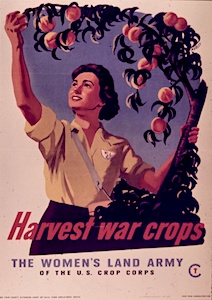
The WLA played a significant role in helping Britain win the war as it helped to provide the country with food at a time when the German U-boats were destroying the merchant ships bring food and other supplies to Britain from America. At the peak of the recruiting campaign for the WLA, there were approximately 80 000 women digging, sowing and driving tractors.
Here are ten interesting facts about the WLA:
- Many of the volunteers for the LWA were recruited from towns and cities, including London;
- Many land girls lived in hostels. By 1944, 22 000 land girls were living in 700 hostels;
- The WLA had a uniform and there were strict rules about how to wear it;
- Approximately 25% of the land girls were employed in some sort of dairy work;
- Some land girls were employed as rat catches. They had to tie strings around the legs of their trousers so that the rats didn’t run up inside them [Yuk!];
- Land girls were paid less than men for the same work;
- The botanical gardens at Kew in Surrey employed land girls to help maintain them;
- Land girls were used for land reclamation projects, particularly in East Anglia where thousands of acres of fenland (low and marshy ground) were drained;
- There was a specialist forestry branch of the land girls called the Timer Corps to help source and prepare wood. They were called lumbergills; and
- The land girls worked alongside Italian prisoners of war.
The WLA was very successful and made available many more men to fight in the war. The present-day Queen Elizabeth was the patron of this organization throughout the war.
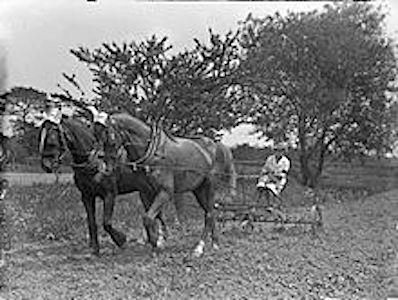
While the Bombs Fell
My mother and I have written a book about her experiences growing up in the English town of Bungay in East Anglia. The land girl who worked on my grandfather’s farm during WWII is featured in our book called While the Bombs Fell.
This is a short description of Mavis, the land girl, and the work she did on the farm:
“A tall and muscly woman, Mavis cut her hair into a short bob and wore a bibbed pair of overalls.
She stood in the milk float ready to set off on her round through the town, dropping off pint bottles of milk on people’s doorsteps.
As Elsie watched, the land girl flicked the reins and away she went.
Mavis had already been up for hours and helped Father and Reggie to milk the cows, bottle the milk, and stack the bottles into the crates that they then loaded onto the milk float.
The trio carried the pails of milk to the dairy and tipped their contents into a milk cooling machine. The milk cooling machine comprised of pipes that pumped cool water upwards as the milk flowed down over them into the spotlessly clean milk bottles. The quicker the milk cooled down, the better its quality would be.
Father always said, “The milk bottles must be kept clean. Otherwise, the milk will go sour, and that would be a disaster.”
Later in the day, Mavis would muck out the cows’ stalls and hose them down. She would shovel the manure onto a wheelbarrow and then push it down to the pyramid of cow poo at the bottom of the yard, where she would add it to the growing pile. As the manure dried, it formed what appeared to be a firm crust.
Elsie remembered the day when Joey dared Reggie to climb to the top of the pile. The other children watched as Reggie rose to the challenge. Reggie had soon discovered that the dry firmness of the crust was an illusion. Two steps in, he started sinking into the squelching green muck and took a flying leap out of the pile, back onto solid ground.
Mavis would work all day and help to milk the cows again in the evening before going home to care for her son.”
Purchase While the Bombs Fell

Amazon:
 Chris The Story Reading Ape's Blog
Reblogged this on Robbie's inspiration and commented:
The Story Reading Ape is hosting my mom and I today with a post about the Women’s Land Army in the UK and an extract from While the Bombs Fell. Thank you for having us over, Chris!
LikeLiked by 1 person
Welcome, Robbie 🤗❤️🤗
LikeLiked by 1 person
Reblogged this on Smorgasbord – Variety is the spice of life and commented:
Robbie Cheadle and her mother, Elsie Hancy Eaton, have collaborated on a novel based on Elsie’s experiences as a child during WWII – When the Bombs Fell… read an excerpt and buy the book..
LikeLiked by 2 people
Thank you for your support, Sally. Much appreciated as always.
LikeLiked by 2 people
Pleasure Robbie have sent you an email.. offline most of the time for another few days and then will catch up with promotions.. hugs
LikeLiked by 2 people
I hope you are having a wonderful time, Sally
LikeLiked by 2 people
It has been great thank you Robbie.. batteries recharged for the last part of the year.. xx
LikeLiked by 1 person
Many thanks for sharing, Sally ❤️
LikeLiked by 1 person
This is a fascinating post, Robbie.
It would be interesting to know how many of those landgirls, who worked with the Italian prisoners, ended up marrying one of them. On the law of averages there must have been a number of romances stemming from working in such close proximity.
LikeLiked by 2 people
Oh, yes, there were lots of romances. A lot of English ladies also married the US soldiers and went back to the US with them. WWII laid the foundation for the great friendship that still exists between Britian and the US. I didn’t touch on the Italian POW’s in this first book but they come into the second book. The air base near Bungay was used to house the Italian POW at the end of the war and my mother can remember some interesting things about them.
LikeLiked by 2 people
I just purchased the book on Kindle…thanks for sharing this, fascinating!
LikeLiked by 2 people
Thank you, John. I hope you enjoy it.
LikeLiked by 2 people
Women ROCK! It is terrific to remember that there was so much women were responsible for while our brave men were taking care of what they were responsible for. ❤
LikeLiked by 4 people
The two world wars really changed life for women, Annette. They realised that they could do jobs like farming when the need arose.
LikeLiked by 2 people
Having come from the other side of the Atlantic, I find it fascinating. Does the book touch on the fact that the women were paid so much less than the men? One can only imagine what they had to put up with and what became of them after the war. Best wishes with the book.
LikeLiked by 2 people
Thank you for your comment, Lea. The book doesn’t specifically state the differential in pay but it does clearly define the different roles of males and females at that time, including the roles for children.
LikeLiked by 1 person
Very interesting and I thank you for responding.
LikeLiked by 2 people
Life was so different for women during the war, and it paved the way for many changes. Thanks, Robbie, for sharing, good luck with your book, and thanks, Chris
LikeLiked by 3 people
It was the two wars that really changed things for women in Europe. A fascinating time to read and learn about. Thank you for your support, Olga.
LikeLiked by 2 people
My mother in law and one of my wife’s older cousins were both in the WLA during WWII and my wife currently does presentations wearing the uniform in old peoples homes as Land Army Betty, nice to see the WLA mentioned here.
LikeLiked by 3 people
I am sure they both have interesting stories to tell of this time. Thank you for reading and commenting.
LikeLiked by 2 people
Marvelous! Chris, thank you for hosting Robbie. So interesting. Best to her with this book. Mega hugs!
LikeLiked by 2 people
MFHs back, Teagan ❤
LikeLiked by 2 people
Thank you, Teagan, this book is generating a bit of interest so I hope it will do well. Thanks for your support. Hugs back.
LikeLiked by 2 people
Wishing you huge success with it Robbie. Perhaps this is the perfect moment in time for it. 🙂
LikeLiked by 1 person
Thank you for sharing this post, Chris
LikeLiked by 1 person
Welcome, Robbie ❤
LikeLiked by 1 person
Robbie, I just purchased your memoir on kindle and cannot wait to read it
LikeLiked by 2 people
Thank you, John. I appreciate your support and hope you enjoy it.
LikeLiked by 2 people