
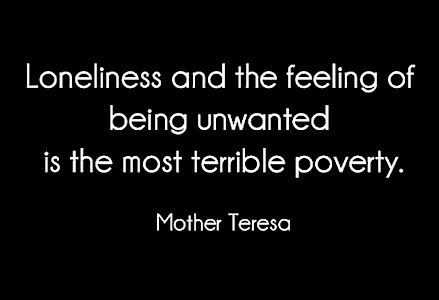
We fear loneliness, so we’re often frightened of being alone and place little value on solitude these days. Many people seem to feel singleness is a parlous state to be criticised or regretted, though so many people live alone these days. We live in a world that is becoming more and more intrusive and the intrusion more acceptable. The ease with which we can connect with family and friends tends to increase our dependency on others. Everywhere we look, people are hugging their phones to their ears or texting a message to someone, clinging to their instrument, as though it will allow them to actually touch the correspondent.
 But are we depriving our children of the opportunity to be independent and enjoy their own company? Previous generations of children were usually expected to play with the other children on the street or amuse themselves with their siblings or on their own— mostly outdoors and generally only loosely supervised by adults. Older generations are nostalgic about the freedom they enjoyed in childhood, the adventures they had and the excitement of exploring the world around them. Today’s young spend much less time in unorganized activities or doing “nothing”—a state in which all kinds of great ideas may be formed.
In earlier centuries, privacy was hard to come by. Houses for most people were much smaller, families often accommodated several generations and much of the work was home based. It was only in Victorian times that privacy or the hope of it became a possibility; the world expanded and those who wished to escape the eyes of their families and the interest of their neighbours had a better chance of doing so. In the twentieth century with the increasing mobility of the population, anonymity in cities became assured and privacy within the reach of most.
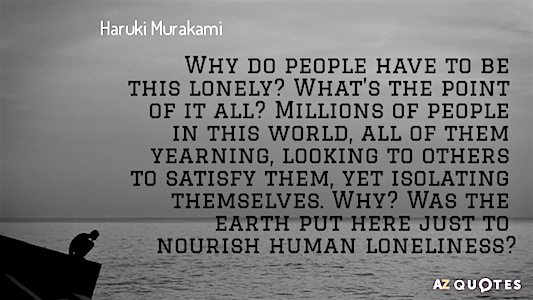
Why is it then that we seem to have lost sight of the importance of independence and privacy and no longer regard solitude as something that nurtures self-reliance? A chosen solitude is a “cradle for creativity” as any writer knows. Even when it is imposed there are some who have survived their confinement by reading and writing, for these activities are often consciously chosen to achieve solitude, even when surrounded by others. And who has not looked forward to and enjoyed solitary walks in parks, woods or on moors and hills, whether or not accompanied by a silent canine companion.
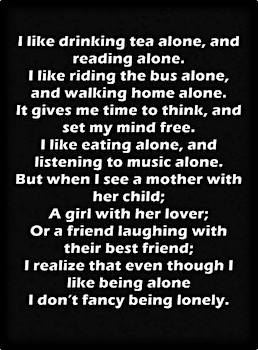
Sara Maitland, the author of How to be Alone (The School of Life) available on Amazon, suggests that modern western society has become deeply confused about solitude.
We think we are unique special and deserving of happiness, but we are terrified of being alone.
We declare that personal freedom and autonomy is both a right and a good, but we think anyone who exercises that freedom is “sad mad or bad. Or all three at once.
Her book is provocative rather than profound, but her defense of her own solitude is passionate, as is her case for the value of “being alone”. She raises a number of issues that might concern those who find themselves alone, but not of their own volition, and does her best to allay such fears. As a “how to” book, How to be Alone offers clear suggestions for how one can reconcile a life of solitude and still maintain the connections with family and others that are important to us. I recommend it as an interesting examination of the benefits of solitude and how one may achieve it without falling prey to loneliness.

Amazon:
 Chris The Story Reading Ape's Blog
Wonderfully defined. 🙂
LikeLiked by 1 person
Reblogged this on Random Ramblings; Myriad Musings and commented:
I usually don’t promote the books of others, as requests for assistance with mine have gone unanswered – but, this one is worthy!
😎
LikeLiked by 1 person
Thanks for sharing Sep 👍😃
LikeLiked by 1 person
A beautiful and thoughtful post on aloneness and loneliness, Felicity. I relish my periods of solitude, but that is very different from unwanted isolation. I feel a little sorry for many of the young people today whose lives are a constant barrage of contact. There’s little time to look inward and reflect, and who is more alone than someone who has no opportunity to connect with oneself. ❤
LikeLiked by 1 person
What a thoughtful and probing post on being alone.
I want to put in a plug for Felicity’s book, Alone, about a 12 yr old boy left alone to manage a small homestead for 6 wks while his father fetched the rest of the family. A well researched story, beautifully written and illustrated. How does he spend his time? What does he think about? How does he handle loneliness? A thought-provoking read for today’s screen-obsessed generation.
I need a balance in my life, a balance of time alone and time with other people.
Patricia Calder
LikeLiked by 1 person
Reblogged this on TINA FRISCO and commented:
In solitude, some experience loneliness ~ feeling that no one cares ~ while others experience it as merely being alone. Felicity Sidnell is a guest on The Story Reading Ape’s blog today and asks a compelling question: “Why is it then that we seem to have lost sight of the importance of independence and privacy and no longer regard solitude as something that nurtures self-reliance?” Food for thought…
LikeLiked by 2 people
Many thanks for re-blogging Tina 😀 XXX
LikeLiked by 2 people
Welcome, Chris 🙂 XXX
LikeLiked by 1 person
Sep, I tried to comment on your 6th anniversary post, but WP won’t let me! So I’ll comment here: HAPPY 6th ANNIVERSARY, Sep! May you have many more ❤ P.S. Loved all the music 🙂
LikeLiked by 1 person
Reblogged this on Don Massenzio's Blog.
LikeLiked by 1 person
Many thanks for re-blogging Don 😀
LikeLiked by 1 person
You’re welcome
LikeLiked by 1 person
I love reading Felicity’s posts on your blog, Chris. Thank you both!
LikeLiked by 1 person
Reblogged this on A Blog About Anxiety and Depression and commented:
Thank you for sharing your wisdom and knowledge with regards to this matter. It shows a glimpse of reality around us, there is indeed a significant difference between the past and present generations. I hope that this article may enlighten other people.
LikeLiked by 1 person
Reblogged this on Kate McClelland.
LikeLiked by 1 person
Thanks Kate 😀
LikeLiked by 1 person
A very thoughtful post. I do think our children view being alone differently from previous generations – we haven’t given them the opportunity to develop the richness of thought, creativity and fantasy that comes from spending some time alone with just your brain!
LikeLiked by 1 person