
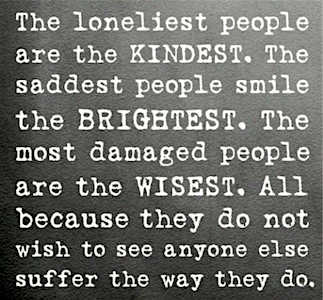
We fear loneliness, so we’re often frightened of being alone and place little value on solitude these days. Many people seem to feel singleness is a parlous state to be criticised or regretted, though so many people live alone these days. We live in a world that is becoming more and more intrusive and the intrusion more acceptable. The ease with which we can connect with family and friends tends to increase our dependency on others. Everywhere we look, people are hugging their phones to their ears or texting a message to someone, clinging to their instrument, as though it will allow them to actually touch the correspondent.
 But are we depriving our children of the opportunity to be independent and enjoy their own company? Previous generations of children were usually expected to play with the other children on the street or amuse themselves with their siblings or on their own— mostly outdoors and generally only loosely supervised by adults. Older generations are nostalgic about the freedom they enjoyed in childhood, the adventures they had and the excitement of exploring the world around them. Today’s young spend much less time in unorganized activities or doing “nothing”—a state in which all kinds of great ideas may be formed.
In earlier centuries, privacy was hard to come by. Houses for most people were much smaller, families often accommodated several generations and much of the work was home based. It was only in Victorian times that privacy or the hope of it became a possibility; the world expanded and those who wished to escape the eyes of their families and the interest of their neighbours had a better chance of doing so. In the twentieth century with the increasing mobility of the population, anonymity in cities became assured and privacy within the reach of most.
Why is it then that we seem to have lost sight of the importance of independence and privacy and no longer regard solitude as something that nurtures self-reliance? A chosen solitude is a “cradle for creativity” as any writer knows. Even when it is imposed there are some who have survived their confinement by reading and writing, for these activities are often consciously chosen to achieve solitude, even when surrounded by others. And who has not looked forward to and enjoyed solitary walks in parks, woods or on moors and hills, whether or not accompanied by a silent canine companion.
Sara Maitland, the author of How to be Alone (The School of Life) available on Amazon, suggests that modern western society has become deeply confused about solitude.
We think we are unique special and deserving of happiness, but we are terrified of being alone.
We declare that personal freedom and autonomy is both a right and a good, but we think anyone who exercises that freedom is “sad mad or bad. Or all three at once.
Her book is provocative rather than profound, but her defense of her own solitude is passionate, as is her case for the value of “being alone”. She raises a number of issues that might concern those who find themselves alone, but not of their own volition, and does her best to allay such fears. As a “how to” book, How to be Alone offers clear suggestions for how one can reconcile a life of solitude and still maintain the connections with family and others that are important to us. I recommend it as an interesting examination of the benefits of solitude and how one may achieve it without falling prey to loneliness.

Amazon:
 Chris The Story Reading Ape's Blog
Reblogged this on Felicity Sidnell Reid: author, editor and broadcaster.
LikeLiked by 1 person
Thank you, lovely post. Feelings of isolation are hard to bear. Being alone can be a gift.
LikeLiked by 1 person
Thank you, Susan, for reading it and writing your comment.
all best wishes Felicity
LikeLiked by 2 people
Each experience of loneliness, I expect, is unique. It is not always comfortable but I believe can be valuable if it is approached with curiosity and a willingness to learn from it. Being alone and loneliness, are, after all, quite different things. For the writer it gives space to examine characters in depth and relate to them more fully. Loneliness is part of life’s ‘rich tapestry’ and, whenever possible, should be tackled with creativity rather than accepted.
LikeLiked by 4 people
Thanks, Wendy. I agree with your comment about loneliness, though perhaps I would say “best tackled” as loneliness does present a huge challenge to many people.
LikeLiked by 2 people
You are absolutely right and some days it will be easier to tackle than others. The challenge is always there.
LikeLiked by 1 person
Reblogged this on Smorgasbord – Variety is the spice of life and commented:
Felicity Sidnell with one of her thoughtful posts as a guest of The Story Reading Ape on the subject of Loneliness. You can feel lonely even when you are part of a relationship or a group but I discovered that the art of being alone is a very useful one to possess.
At a very young age and due to financial restrictions I had six months self-imposed isolation in the Welsh Mountains.. didn’t drive.. was caretaking the hotel I worked in during the season in the winter months. I had no phone, no computer in those days and a black and white television. I wrote some of my best stuff during that time. I have never felt lonely since. Head over and share your thoughts with Felicity and Chris..
LikeLiked by 4 people
Thanks for spreading Felicity’s post Sally 😀 Hugs XXX
LikeLiked by 1 person
Thanks so much for re-blogging this, Sally, and for your very illuminating and encouraging comments! Hugs from me too!
LikeLiked by 2 people
thanks Felicity.. x
LikeLiked by 1 person
Interesting post. I enjoy solitude, but the point is that i want to choose when to experience it.
LikeLiked by 4 people
Thanks for writing, Mick. I sympathize with your view-point.
LikeLiked by 2 people
There’s another side to this. It seems a lot of criminals are solitary- think serial killers etc so there seems to be something suspicious about solitude. Or even dangerous which makes harassment of single especially old people more possible
LikeLiked by 2 people
Thanks for writing, Barb.
LikeLiked by 2 people
Boggles the mind. Sometimes, it’s a question of do we want to be alone or not? I’ve read about a trend that after divorce, men and women prefer to live alone more and we know there are a lot of divorces. 🙂
LikeLiked by 3 people
Reblogged this on WENEZIA™ – Weidens neue Mitte!.
LikeLiked by 1 person
Thanks so much for re-blogging this.
LikeLiked by 1 person
Hello, best thanks to you! 😉
LikeLiked by 1 person
It’s hard being lonely especially when you’re not alone…
LikeLiked by 4 people
How true!
LikeLiked by 2 people
The lonlieness of a divorced or bereved person is very different to someone feeling and being alone within a relationship/ marriage.
LikeLiked by 2 people
❤
LikeLiked by 2 people