
A reader was confused.
After reading a persuasive blog post about the value of Pinterest, he inquired of the writer, “Is it possible for authors to use Pinterest to get attention to their writing.
I only have one word for this reader and anyone else wondering.
Absolutely!
Pinterest has great value for writers and anyone looking to grow their readership due to the vast amount of people using Pinterest.
More than 60% of all consumers get information visually, by looking at pictures. Pinterest is comprised of these graphics, or pins, displayed on virtual bulletin boards.
The answer for writers looking to use Pinterest to grow their audiences is simple—use Pinterest bulletin boards to get interest in snippets of your writing.
How to Use Pinterest Boards to Create Interest in Your Writing
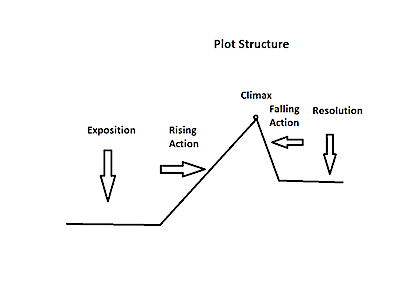
The diagram below shows a basic plot structure. If you make a Pinterest board for each element of your plot, you will create and maintain interest in your story.
Exposition
The exposition of the story establishes the setting—the time and place of your action—and establishes the characters.
- Make an account at Pinterest.com.
- You will have an opportunity to identify yourself as a writer and to give the link to your website.
- Click the + sign to create a Pinterest board.
- Name the board. Use hashtags, so when Pinterest users look for graphics, they can find your board.
- Describe the board as the time your story is set in. Past? Present? Future? Be specific—the Stone Age? The Space Age? The Age of Exploration? You get the idea. Use hashtags in front of key words, so people looking for the images you place on the board can find your pins.
- Find pins to add to the board.
- Go to the search bar and type in the time period in which your story is set.
- When you find graphics that represent your plot’s time-period, click “pin it”. Hovering over the graphic will bring this up.
- Look for an icon of a pencil. Clicking it will bring up an editing function. You want to edit the description of the pin.
- Use hashtags in front of relevant key words.
- You will be asked which board you want to pin the graphic to. Click “Time Period” or whatever you named your board.
- Continue to do this until your “Time Period” board has at least six pins.
- Repeat steps 3 through 6 for your “Place” board.
In the Pinterest search bar, search the place your story is set. You can be as broad or specific as you want. However, the broader the place you identify your setting as on your Pinterest board, the easier it will be to find at least six graphics to pin.
Note when tagging your “place” pins:
“Travel” is one of the nine most common Pinterest hashtags there is. Since your board is about a place, and people travel to places, this is a relevant, and extremely popular, hashtag. Use it when tagging your “place” pins. (Do people travel to places during the action of your story? Remember to tag those pins “travel”.)
- Repeat steps 3 through 6 for your “characters” board.
Is one of your main characters a housewife? Show pictures of housewives. Sue Coletta is a crime writer. If one of her main characters is a homicidal killer, she could pin graphics of killers, for example.
“Kids” and “pets” are also extremely popular trending hashtags. If these are important characters in your plot, be sure to use these hashtags to identify your pins.
Rising action
Rising action occurs when the conflicts begin. Two opposing forces comprise a conflict. Someone struggling internally or against nature still has a conflict.
For example, is someone in your story ill? Pin graphics of sick people. The graphics of problems you pin should represent main problems in your plot, or the people you are trying to win over to your site could feel misled.
Follow steps 3 through 6 under Exposition above and create your “Rising Action” board.
Problem Complication is the next part of a plot. These are events that complicate the problems in your rising action.
For example, if the prosecutor in a story needs to win a case or his career is over (problem), but the defense attorney is his secret crush and winning the case means his chances of winning his love are diminished, the main character’s problem has just been complicated.
The Rising Action board would showcase graphics of trial lawyers while the Problem Complication board would show pins of romance or broken hearts.
The climax is the part of the plot where the readers’ interest piques. The most intense scene of the story is described in the climax.
You walk a fine line here. You want to how just enough to stimulate interest in your literature but not enough that potential readers will start screaming “Spoiler alert!”
For example, will the defendant confess in the climax? (Spoiler alert). However, you could show a courthouse, the location of the climax. A juror’s box and a witness stand wouldn’t reveal the end to your story or book.
The Falling Action shows what happens after the climax. The action falls since the intensity has dropped.
Does the prosecuting attorney get promoted for a great effort and wins the girl? Again, choose your pins carefully to avoid spoiler alerts.
The Resolution explains how your story ends. Are they now friends or is there a lingering grudge? Do the characters go home together or separately? Showing a house will not reveal who is in the house, so you won’t be spoiling your ending.
In conclusion, there is a massive amount of people using Pinterest. The number of pinners continues to grow.
You can pique their interest in your writing by following these tips. The more boards you have, the more pins you will have. The more pins you have will generate that much more interest in your literature.
There are more tips for how to use social media to generate interest in your literature over at my site, MostlyBlogging.com, so please call over and check out my other suggestions for engaging readers, improving content, and increasing traffic as well (and I’d love it if you subscribed to the blog).
 Chris The Story Reading Ape's Blog
Thanks so much for this. I’m always looking ofr ways to use Pinterest because I think I’m not using it at its full possibilities. I’ve never thought using it this way. I think I’ll try it 🙂
And I was wondering, do Pinterest users really use hashtags? I’ve heard people use them, but I’ve never actually seen them used.
LikeLiked by 1 person
Hi Jazzfeathers,
Thank you for reading my article and commenting. I have read many articles about Pinterest and put what I’ve read into practice. I’ve watched YouTube videos about how to best use Pinterest as well. The answer is yes. It is how pinners search at Pinterest. However, more than two hashtags to tag a pin is considered overdoing it. In my article I mentioned some of the more popular hashtags. Using those will get you far. Thank you for your question.
Janice
LikeLiked by 2 people
Thanks so much for answering. Uhn… then I think I should start using them.
I use them on Twitter (of course) and never more than 2. I find I can’t read tweets with more than 2 hashtags.
LikeLiked by 1 person
So, you have proven the research is correct1 Thanks for sharing.
Janice
LikeLiked by 1 person
Reblogged this on Jo Robinson.
LikeLiked by 1 person
Hi Jo!
Thank you so much for reblogging my Pinterest article. As a self-hosted blogger, I can no longer be reblogged. I am flattered, and truly grateful for the exposure to your readers since I am trying to expand my readership on my new site.
Janice
LikeLiked by 1 person
Thanks for re-blogging Jo 😀 xxx
LikeLike
Apparently, if you have a Shopify account, you can now link directly from your pins so people can click on your pin and buy your merchandise.
LikeLiked by 1 person
I think that may only be in the US though.
LikeLiked by 1 person
Hi Wendy,
That would be wonderful; I had not heard this. Perhaps authors can connect the pins to book sales that way. Thank you for the idea and commenting on my article. Nice to meet you.
Janice
LikeLiked by 1 person
Thanks for that information Wendy 😀
LikeLiked by 1 person
Reblogged this on Kawanee's Korner and commented:
This looks interesting I’m going to look at it in the morning see what I need to do to get started
LikeLiked by 2 people
Hi Kawanee,
Nice to meet you. Thank you so very much for reblogging my article, so new readers can be exposed to my writing. Thank you for your comments.
Janice
LikeLiked by 2 people
You’re quite welcome. I need to get started using pintrest! 😀 I’m working on visual teasers that might be better received in that format so I’m going to see what happens.
LikeLiked by 1 person
Thanks for re-blogging Kawanee, I hope the article helps you 😀
LikeLike
Thank you very much, now I know
LikeLiked by 2 people
Hi Gigi,
I am so glad I read that comment by the author regarding Pinterest, so I can explain to Chris’s community how to use Pinterest to their advantage. Thank you for reading what I wrote and commenting.
Janice
LikeLiked by 1 person
Reblogged this on S.K. Nicholls and commented:
If you have wondered how to use Pinterest to your advantage as an author, well, here you go!
LikeLiked by 2 people
Thanks for re-blogging Sue, I hope the article helps you 😀
LikeLike
My pleasure.
LikeLiked by 1 person
I’ve heard folk say to use pinterest, but I’ve never had anyone able to tell me HOW to use it. Thank you so much for this informative piece.
LikeLiked by 2 people
Thank you so very much. I’m glad you enjoyed my article. It was my pleasure to help Chris’s readers. Thank you for your comments.
Janice
LikeLiked by 1 person
I just used your suggestions and set up a page. Take a look and follow if you like. Let me know if you have a board I can follow. https://www.pinterest.com/seapeachcove/red-clay-and-roses/
LikeLiked by 1 person
I didn’t use hash tags and it’s not as well organized as it will become, but it’s a start. HA!
LikeLiked by 1 person
Be aware that Pinterest can be very addicting–it is that much fun. I find it relaxing as well.
As far as organization, you raise an important point. Put your most important boards first. Pinners will start scrolling through your boards and may not make it to the important boards. Everyone is busy. Put the ones you want people to see first. You can move boards around at Pinterest. Thank you again for your comments, so I could explain to organize boards in order of importance.
Janice
LikeLiked by 1 person
Hi Sue,
1. I clicked the link and saw your board. You did all that just now? 37 pins?! Impressive! I found your content intriguing since I teach history.
2. You asked if I have boards. Yes, I am just starting a new self-hosting web site. I just started pinning my pins from my blog to the board:
Also, I have a board exclusively for followers of my blog, Mostly Blogging.
Thank you again for your interest in my article.
Janice
LikeLiked by 3 people
I discovered if I copied the words I wanted, the pin would still shine through the copy, I could click pin them and get both the pic and the words for pinning.
LikeLiked by 1 person
Amazing. Thank you for explaining. It’s been a pleasure meeting you.
Janice
LikeLiked by 2 people
Hi Chris,
I came back to click “Notify me of new comments via email,” so I can read what your followers thought of my article. Thank you again.
Janice
LikeLiked by 1 person
Great idea Janice 😀
LikeLike
Reblogged this on cornfedcontessa and commented:
Great post! Thanks for sharing.
LikeLiked by 2 people
Thank you so much for reblogging my article! I am always grateful for the exposure to new readers.
Janice
LikeLiked by 2 people
You are welcome!
LikeLiked by 2 people
Glad you liked it Contessa and thanks for re-blogging 😀
LikeLiked by 1 person
Dear Chris,
Thank you so much. I am grateful for this opportunity to introduce myself to your readers. Thank you for hosting me.
Janice
LikeLiked by 1 person
Very Welcome Janice 😀
LikeLike