
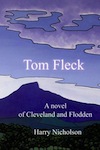
On the 9th of September this year, many will gather six miles south of the Tweed to mark the 500th anniversary of the Battle of Flodden. In 1513, at the foot of a hill, James IV of Scotland met his death, along with most of his aristocrats, at the head of a huge Scottish army. Such was the loss at Flodden it was said that Scotland must then be ruled by children.
Tom Fleck, a humble Yorkshireman, and his shepherd dog, are caught in the confusion of an international war.

When I tapped out Morse in the pitching wireless cabins of tropical steamers, it was not in my mind to write a novel– though, in those long voyages I exhausted the books in the ship’s library.
The career in television studios, that followed, might have brought it about – thirty years working with stories in pictures does soak the mind with images. Now I’ve retired perhaps I’ve reached a good age to be a teller of stories.
This story is about ‘Tom Fleck’ and his struggles to be a free man in Cleveland, North Yorkshire, but a Cleveland of five centuries in the past.
The story of an unknown man.
It is the first session of a creative writing course in Whitby. The tutor is from Scarborough and does not mess about. He calls out, ‘I want a fifty-thousand word draft of a novel from you lot by the end of term. You can take the theme: ‘something lost and something found’’.
I mutter, ‘In that case, I won’t be here next week, I signed on in the hope of sprucing up my poetry; a few bits of prose maybe – but not a novel!’ However, I took a liking to the fellow and, the next week, handed him a thousand words about a poor man who found a gold ring. A simple enough idea.
His response: ‘This is fantastic, and I’m not just saying that. Drop everything. You’ve got to write this novel. It will be a year out of your life.’
It took four years.
Tom is a young Cleveland (North Yorkshire) farm labourer living in 1513, the fourth year of Henry VIII. I’ve drawn out a character from the unrecorded masses, so that we can engage with the lives of ordinary people of the Tudor North East. He lives before 1566 and the beginning of parish registers so, like his humble neighbours, he leaves no record. Such is a beauty of fiction – we can use it to breathe life into lost generations.
We find his rare surname eighty years later in the register of St. Hilda’s church at Hartlepool:
Baptisms 1596, September 19th: Christoferye child of Willm. Fleck.
I like to imagine that William heard tales of how his great grandfather, Thomas Fleck, loved a strange woman and stood with the army on the terrible battlefield of Flodden. This story brings him to life.
The characters seemed to manifest on stage as they wished and I was startled at how they came to inhabit and then to control the story. I chose the year 1513 because an international conflict would disturb the humdrum lives of the Flecks.
I’d not expected that the struggle on Flodden Field would become such a dominant feature – but it drew me in.
The mood of the times was gradually built over the next four years. The journey was rich; it led to fascinating places and sources:
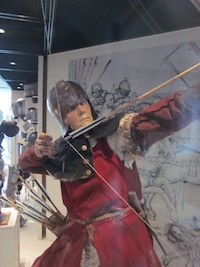
I’ve squinted through glass at The Royal Armouries at Leeds, made notes of the footwear of archers and saw how they slung their arrow sacks, gawped at the metalwork of the English bill and the Scottish Lochaber axe; wondered at the unwieldiness of the 18-foot Swiss pike.
A friend’s comment caused a rewrite. He insisted that only yeomen (men with investment in the land) were allowed the long bow. Common labourers were not trusted with the equivalent of the modern rifle. I had now to find good reason for lowly Tom Fleck to carry his grandfather’s bow.
The same friend was writing a serious study of the drovers and drove roads of the North country. I listened carefully. It seemed to me that Tom Fleck could wander those same lost tracks.
Each Christmas I’d chat up my son’s partner, who is a herbalist, to discover more about the old ways of healing among the peasants.
After the first draft, I discovered that the surname Fleck is not in fact a Cleveland name – but hails from Galloway! It would be simple to change Tom’s surname, but it would be very interesting to give him Scottish forebears, particularly as he would face the Scots on Flodden Field.
An expert pointed out: ‘You can’t have Rachel Coronel in the story; the Jews had been banished and did not return until Oliver Cromwell’s time’. Rather than cut her fascinating character and that of her father, I dug and dug. Oh the relief to discover that a small number of useful Jews were permitted in London. It was a visiting Iberian Jew who warned Queen Elizabeth that Spain was building the Armada.
And when you have hints of love between cultured Jew and Yorkshire labourer – what would be the outcome? This led to interesting issues in an England just a few years before the Reformation.
So – to the novel. Here are some excerpts from the novel – fragments of Tom’s landscape and life:
He is with his father, in search of treasure at a Bronze Age burial mound on the Cleveland Hills:
They waited for a day of drizzling low cloud when they could dig the mound in secret. Clear weather would paint them, like standing stones, against the skyline. Francis sat on a rock in the clinging mist and, grey-faced, stared at the burial mound. His eyes closed and his face softened. Not for the first time Tom watched his father fall into a trance.
Tom has a sister, Hilda:
She fixed him with a desperate stare and struggled to speak. ‘Where else can we live? We can’t just wander the tracks from parish to parish. But I don’t want to stay here, not now Mam and Dad are gone.’ She let out a sobbing cough.
Tom stopped eating and moved to her side. He put his arms around his sister and felt the trembling of her thin shoulders. ‘Now, don’t fret. We will have our own spot. There’ll be apple and damson trees, with hens of all colours scratching about underneath. Mind – thou will have to tend them. Meg can have some pups and they’ll have white stars on their foreheads like her own. I see a milking nanny goat to build you up and you’ll have a cosy bedchamber – with a mirror of polished brass so you can see to comb through your bonny locks.’ He stooped to kiss the crown of her head.
She straightened up and hugged him. Then, pushing him away, she wiped her eyes with the back of her hands and giggled. ‘Have a care! I might hold you to that! Now eat your supper.’
They have a neighbour:
Agnes Humble stood, knife in hand, staring, as she often did, towards the single-toothed outline of Roseberry Topping. The hill reared up in isolation as though cast adrift into the Cleveland ploughlands from the dark crags of the moor edge. As a girl she had done some courting on the sheep-cropped turf of that hilltop. Each morning when she looked that way, she remembered him and those bright days. Where has all the time gone?
He is tested on the Scottish border:
‘Form into a column fifty men wide,’ a breast-plated marshal shouted above the chanting of the priest. ‘Stay to this side of the beck. Follow Saint Cuthbert’s banner.’
However, let’s not give too much away.
The novel took a while longer than expected. It trundled for a year while I studied creative writing with the Open University. When I finally hit the keys for ‘The End’ and went on to revise. Then I began to agonise over semi-colons and the like, and Mark Twain’s rule of: ‘When you see an adverb – stamp on it’.
Tom Fleck became alive and walked out of his humble life to range across the North, over County Durham, the Land of the Three Rivers,
The first chapter is on my Blog: HERE
There are also poems, short stories and some art work.
‘Tom Fleck’ a Novel of Cleveland and Flodden, is now in its second (revised) edition and is in paperback and in eBook, for all readers. It can be found at Amazon or Smashwords. Click HERE to get further details.
I’m now working on a sequel. It finds Tom Fleck twenty-three years older in 1536, at the start of the Reformation and big trouble for the North of England.
My short stories and poems are in eBook form. ‘Green Linnet‘ is at the usual eBook outlets. Click HERE for further details.
You will find information about Flodden HERE
And Remembering Flodden HERE
And a dedicated Facebook page HERE
Thanks for reading this.
May you find enjoyment.
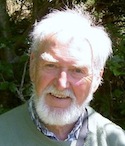
Harry Nicholson
 Chris The Story Reading Ape's Blog
Thank you for publishing my notes on ‘Tom Fleck’. I’m in Northumberland this week and will be walking Flodden Field tomorrow – following the movements that took place on the same times 500 years earlier. I’m in a pub in Seahouses just now, following a wonderful boat voyage and landing on the Farne Islands. Blue sky above a vivid sea, diving terns, eyes of grey seals soft and inquisitive.
LikeLike
I wish you well with the book, Harry. You gave me some useful advice some six or seven months back when I was starting up my blog, so I often think of you and hope things are going well with you. It is lovely to read about you and your work here.
Thanks for this, Chris.
Christine
cicampbellblog.wordpress.com
LikeLike
I bet my dad would like to read that. It’s been a long time since I visited The Armouries.
LikeLike
Sounds like an interesting book, I can see why there’ll be a sequel! 🙂
LikeLike