
A joke about writing, meaning, and interpretation has circulated online for a long time. The idea is that literary analysis often delves far past an author’s intentions into imagining nonexistent meaning, usually in an attempt to establish deeper layers in a piece of writing (and thus justify their reason to analyze).
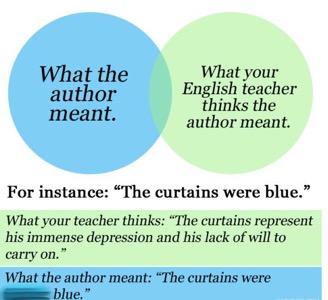
In the joke, a Venn diagram of two circles—”What the author meant” and “What your English teacher thinks the author meant”—barely overlap. The joke is funny because it rings true for many.
From school assignments to book reviews, we might have encountered those with puffed up, self-important, and/or false analyses of stories. (Or we might have half-tongue-in-cheek tried out those methods ourselves to aim for a better grade. *grin*) The general impression is that level of analysis exists mainly to make those doing the analyzing seem smart rather than having anything to do with the story itself.
With the help of the image that commonly shares the joke, the term blue curtains has become a shorthand reference for that style of analysis:
The joke also brings up the question: What’s a story’s “true” meaning (and who defines it)? Let’s take a look…
 Chris The Story Reading Ape's Blog