
by Sarah Fecht  On Popular Science Online:
Glance at the stars, glance back in time.
When we look at stars in the night sky, we’re actually looking back in time. Since it takes a while for light to cross the vast emptiness of the universe—even at a blistering 186,000 miles per second—we’re seeing each celestial object as it looked eons ago. But what if those stars looked back at our pale-blue dot? Here’s what the astral peeping Toms would see.
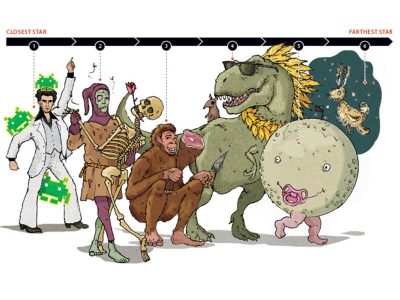
Earths past timeline
1. Trappist-1
From a potentially habitable seven-planet system
DISTANCE: 39 light-years
WHAT’S GOING ON, on Earth:
Sweden becomes the first nation to ban aerosol sprays (over concerns that they damage the ozone layer). Meanwhile, Americans boogie to disco, in vitro fertilization produces its first human baby, and Space Invaders invades arcades.
See more at:
Staring into the Earth’s past
NOTE: you might need to wait through a 10 second ad before the article appears
 Chris The Story Reading Ape's Blog
Fascinating! At the moment I am watching on Netflix a series called Cosmos by Carl Sagan and presented by a former pupil of his. The size of the ‘Multiverse’ (unknown) is so absolutely mind boggling and the fact that we (of course) have no real idea of what is out there, that with each episode I am entertained but more boggled! And, yes, I agree, in the minuscule time life has existed on Earth we have certainly been through some odd shapes and sizes.
LikeLiked by 1 person
I find it all fascinating too, Wendy 😃
LikeLiked by 1 person