
I’ve decided to reminisce about what is an archaic time for many of you denizens of cyberspace who are in your 20s or 30s or even 40s. And the time is the 1930s.
And no, I don’t go back quite that far, but my mother did.
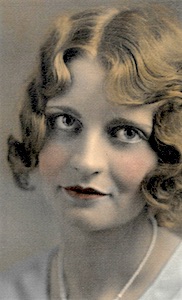
My Mother: Genevieve Raitinger, age ca. 20
She was born in 1909 and graduated from high school in 1927, right before the Great Depression. Her father (my grandfather) was in some ways enlightened for his time. He vigorously condemned smoking, maintaining that putting all that tar and nicotine into your lungs would kill you, and he counseled my mother that she shouldn’t count on having a man to support her and should develop some way to make a living on her own.
When she first graduated from high school, she worked in a shop as a salesperson, but after three years she decided she didn’t want to do that all her life, so she went to college – the same college I attended many years later. It was here in Colorado Springs where I live now – the Colorado College, a small, private liberal arts institution that is well respected throughout the United States. She started in 1930 and graduated in 1934 – right in the depths of the Depression. My grandfather, who was a real estate broker, gave the College a house that he owned to help pay her tuition.
My mother majored in Romance languages, taking four years of Spanish, three years of French, and two years of Italian, and became a secondary school teacher. But when she graduated, she couldn’t find a job and resorted to taking a cosmetology course and working in a beauty shop for a while. Finally, however, she got a teaching job – I think it was 1936 – in a tiny town in southeast Colorado called Hartman. I believe it still exists today. Anybody out there in Hartman reading this?
Remember, this was not only the Depression, it was the Dust Bowl, and southeast Colorado was right in the heart of the drought. The town was losing people, but it did have a consolidated school – grade school and high school all in one building, I believe (I couldn’t swear to some of this). The superintendent was a woman and she proceeded to tell my mother that she would not only be teaching Spanish and English (obviously in a school of that size one had to teach more than first and second year Spanish) – she would also have to direct all the school plays, teach algebra, coach girls’ PE, and (because my mother could play the piano) direct the glee club! My mother always said that she needed the job so badly that she would have swept the floors if her superiors had asked her!
She was always good in math, fortunately, and could manage the algebra, but the text book that they were using had no answer book! So the first year she had to work out every problem herself before she could correct the students’ exercises! It wasn’t exactly easy!
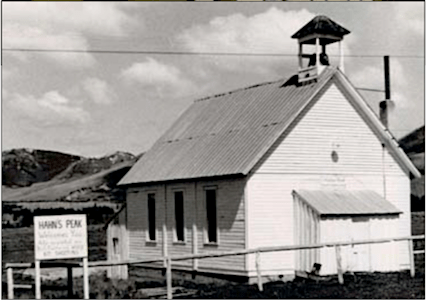
HARTMAN GYMNASIUM School Ave., Hartman State Register 3/13/1996, 5PW.74 The circa 1938 gymnasium is associated with New Deal programs in Prowers County. The Works Progress Administration constructed the facility as an addition to the existing 1930s school. In the early 1980s, the town, then the owner of the building after its closure as a school, demolished the older classroom portion, leaving the gymnasium as a free-standing building. Its use as a community center continues to contribute to the social history of Hartman. Source: History Colorado.Org PDF
The school was so small that everybody could know everybody else. If there was a play practice, students had to have a note from their parents saying they could stay late at night. After the practice, they would make hot cocoa and stand around and “chew the fat” (“talk,” to you). The glee club consisted of a lot of singing around the piano. There was radio, of course, but no other electronic gizmos. The girls played softball or exercised indoors for PE. The boys all thought my mother was beautiful, and I’m sure she was — people told her she looked like Greta Garbo (see accompanying picture).
Another thing a teacher had to do in those days (at least if they were the sponsor of the junior class) was manage the Junior-Senior Prom, which required picking a theme (I think my mother used a Dutch theme once, and once a Hawaiian theme, or maybe it was pirates). Plans could be bought from companies that specialized in that sort of thing, but you still had to make lots of crepe-paper decorations. There was also a competition at Christmas for the best home-room decorations and I believe my mother won it consistently. There was no objections in those days to having a nativity scene in a school. Of course, I doubt if there were very many people in that area at that time that didn’t have a Christian background.

Source: Britannica.com
One thing you didn’t want to do was get caught in a dust storm. My mother said you could see them rolling in across the prairie. Things would get as black as night and the dust would sift in under the doors and on the windowsills. My mother bought her first car in 1937 – a little Ford that cost $600.00 (quite a sum when you’re making $100.00/month on a 9-month contract) – because without transportation she was really stuck in Hartman. One time she said she went to a nearby town and a dust storm rolled in and she didn’t think she would ever get home. But obviously she made it.
My mother stayed in that school for four years and went back later during World War II and taught there another two years. She always said it was one of the happiest times of her life. It was a different time, for sure. But it only goes to show that happiness does not depend on high technology or instant communication; it depends on human relationships and the sense of fulfillment one gains from a rewarding job. I wouldn’t want to go back to that time (because of medical advances, for one thing; even penicillin hadn’t been discovered yet), but there are positive aspects to that kind of lifestyle that perhaps we have lost today.
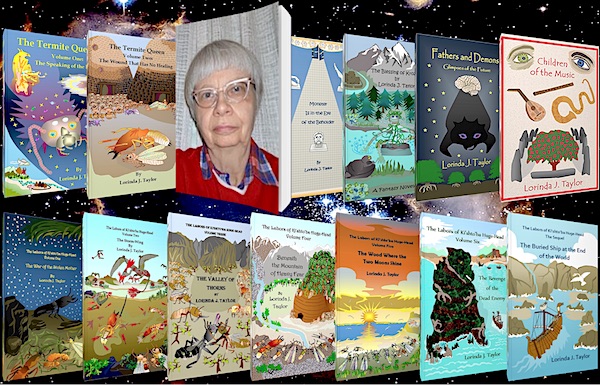
Amazon:
 Chris The Story Reading Ape's Blog
I loved reading this, and it almost made me want to write such a post featuring my mother. However, my mother’s life before she became a bride in WWII was so sad, it would make depressing reading. She had a high school education, but passes values and encouragement on to both my brother and me to the point where we both went on to get Masters degrees (my brother two of them). She was a natural born teacher and taught us creativity above all. Our mothers were very different, but both accomplished an impressive life’s work.
LikeLiked by 1 person
Wonderful story. Thanks
LikeLiked by 2 people
Reblogged this on The Owl Lady.
LikeLiked by 1 person
I knew Chris was going to find some additional pictures, but I’m thrilled to see the picture of the Hartman gymnasium. I should have included it in my essay, because my mother watched it being built, but I had no idea it would look like that (although is the current version). She always said they used to look out the school window and laugh about how the WPA workers were so slow, always standing around leaning on their shovels to make the job last longer. And the picture of the dust storm is spot on!
Thanks, Mr. Ape, for posting this, and thanks to all who commented!
LikeLiked by 1 person
I love revisiting the 1930s and 1940s. Your retelling of your mom’s story is stunning. The wealth of information you have on her past shows how close you were, and also gives you this amazing sense of history that you can pass on to your family. Great post!
LikeLiked by 2 people
Thanks! I have no family to pass anything on to, so I guess my social media friends are my family! ❤
LikeLiked by 2 people
Well, I have a great appreciation for it!
LikeLiked by 2 people