
An extract from a BBC – Culture article:
After news emerged about an underground reading room in Damascus, Fiona Macdonald discovers the places where writing has been hidden for centuries.
Beneath the streets of a suburb of Damascus, rows of shelves hold books that have been rescued from bombed-out buildings. Over the past four years, during the siege of Darayya, volunteers have collected 14,000 books from shell-damaged homes. They are held in a location kept secret amid fears that it would be targeted by government and pro-Assad forces, and visitors have to dodge shells and bullets to reach the underground reading space.
It’s been called Syria’s secret library, and many view it as a vital resource. “In a sense the library gave me back my life,” one regular user, Abdulbaset Alahmar, told the BBC. “I would say that just like the body needs food, the soul needs books.”
Religious or political pressures have meant that books have been hidden throughout history – whether in secret caches or private collections. One of those is now known as ‘the Library Cave’.
The Library Cave
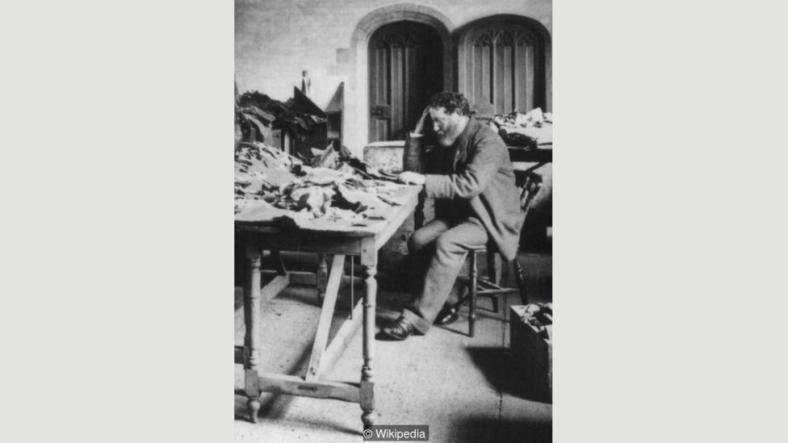
Solomon Schechter recognised the significance of the manuscripts in the Cairo genizah (Credit: Wikipedia)
Not defended by armed guard but by centuries of forgetting, one collection in Old Cairo (Fustat), Egypt was left alone until a Romanian Jew recognised its significance. Jacob Saphir described the stash in an 1874 book – yet it wasn’t until 1896, when Scottish twin sisters Agnes Lewis and Margaret Gibson showed some of its manuscripts to fellow Cambridge University academic Solomon Schechter, that the trove became widely known.
Hidden in a wall of the Ben Ezra synagogue were almost 280,000 Jewish manuscript fragments: what has come to be called the Cairo Genizah. According to Jewish law, no writings containing the name of God can be thrown away: those that have fallen out of use are stored in an area of a synagogue or cemetery until they can be buried. The repository is known as a genizah, which comes from the Hebrew originally meaning ‘to hide away’, and later known as an ‘archive’.
For 1000 years, the Jewish community in Fustat deposited their texts in the sacred store. And the Cairo Genizah was left untouched. “Medieval Jews hardly wrote anything at all – whether personal letters or shopping lists – without referring to God,” says The New Yorker. As a result, “we have a frozen postbox of some two hundred and fifty thousand fragments composing an unparalleled archive of life in Egypt from the ninth to the nineteenth centuries… No other record as long or as full exists.”
Ben Outhwaite, the head of genizah research at Cambridge, told The New Yorker how important the Cairo Genizah collection is for scholars. “It is not hyperbole to talk about it as having rewritten what we knew of the Jews, the Middle East, and the Mediterranean in the Middle Ages.”
 Chris The Story Reading Ape's Blog
Really fascinating! I’ve got a number of these hidden/lost libraries in my book world. 🙂
LikeLiked by 1 person
😀
LikeLike
I’m fascinated by all stories of ancient hidden documents. Just reading the accounts propels you back in time and makes you feel like you’re standing right next to the people who wrote them. Sometimes it makes you wonder if you didn’t have a hand in writing them yourself.
LikeLiked by 1 person
Pity reincarnation doesn’t let you remember Tina 😀
LikeLiked by 1 person
You have to search for the “remembrance,” Chris. We forget only in order to learn the lessons we came here to learn. Otherwise, we’d probably say “forget this crap!” and go on to live an easy but rather meaningless life 🙂
LikeLiked by 1 person
I must look into that Tina 🐵
LikeLiked by 1 person
Outstanding! Only today I borrowed a book from the city library *They Wrote On Clay* by Edward Chiera. Early in chapter one is a photo of the recovery of an ancient clay library.
LikeLiked by 2 people
I suspect we’ll be further amazed by new discoveries Scott 😃
LikeLiked by 2 people
Reblogged this on newauthoronline.
LikeLiked by 1 person
Thanks for sharing Kevin 😃
LikeLike
So very interesting!
LikeLiked by 1 person
indeed 😃
LikeLiked by 1 person
Fascinating.
LikeLiked by 1 person
😃
LikeLiked by 1 person
Wow can you imagine what would happen if they found any part of the Alexandria library?
LikeLiked by 1 person
Indeed Kate 👍😃
LikeLiked by 1 person
Exciting! In my future history, something similar is practiced after the worldwide failure of the electric grid causes all electronic records to be lost. I called it the Underground Archive caches.
LikeLiked by 1 person
I suspect that, like the Universal Seed Repository, there will be more secret libraries made from modern times, in case something happens to Public Libraries and archives Lorinda.
LikeLiked by 2 people
Very Interesting. I did go to link you provided and read the article. I think there is a history within a history all over the world. Things that happened that no leader, King, Pope, etc. wanted to be found out. I hope they do shed light on these documents and we all get to know the real truth.
LikeLiked by 1 person
Glad you enjoyed it – You’re correct, there are still a LOT of hidden gems like this to be discovered, analysed and made public…
Now we know where to look and have the technology to help us, more will come to light. 😃
LikeLike