
If you enjoyed this article, why not share it with all your friends, online connections and groups - GO ON - you KNOW you WANT to!
- Share on Bluesky (Opens in new window) Bluesky
- Share on X (Opens in new window) X
- Share on Facebook (Opens in new window) Facebook
- Share on Tumblr (Opens in new window) Tumblr
- Share on LinkedIn (Opens in new window) LinkedIn
- Share on Flipboard (Opens in new window) Flipboard
- Share on Pinterest (Opens in new window) Pinterest
- Share on MIX (Opens in new window) MIX
- More
 Chris The Story Reading Ape's Blog
Reblogged this on theowlladyblog.
LikeLiked by 1 person
Reblogged this on Kim's Author Support Blog.
LikeLiked by 1 person
Reblogged this on Musings on Life & Experience and commented:
This is great.
LikeLiked by 1 person
I amazes me that there is still so much argument on this point. My stance: there is no real right or wrong with this. It’s more what works for the author and His or Her style. I’m not a fan of using said instead, as it slows things down. I much prefer adding movement, emotion, etc. to the dialogue, otherwise it becomes static and it’s just a bunch of folks standing around talking. Also, when said is said too often, it jumps of the page and pummels me into bored oblivion. Not a fan.
For others, it works. It will never be my preference, though.
LikeLiked by 2 people
Thanks Dellani – I think you’ve probably got it right – if ‘said’ appears too often… 👍😃
LikeLiked by 1 person
I mostly use said or asked, but sometimes emphasis calls for a more descriptive word. You want dialogue tags to mostly be invisible.
LikeLiked by 2 people
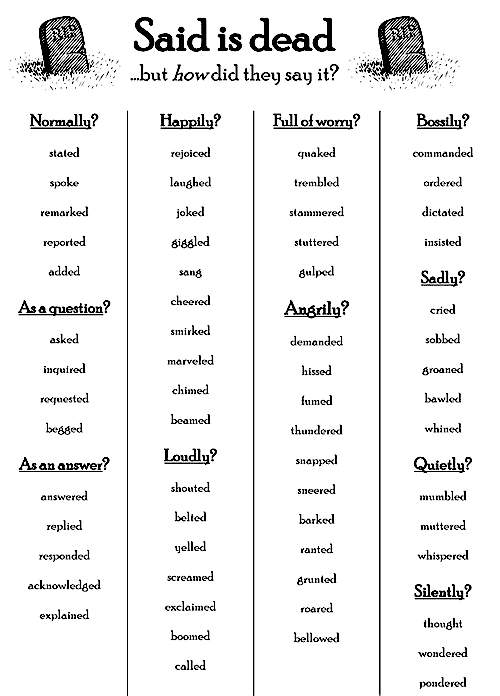
I disagree with this info-graphic. ‘Said’ is the accepted tag. 😉
LikeLiked by 3 people
The consensus of opinion seems to agree with you Tess 😃
LikeLiked by 1 person
And me Tess, I always tell my students that words that used to appear in the Billy Bunter books are a no no. .. ‘expostulates, admonishes, remonstrates, ejaculates… especially ejaculates!! Can never understand why the whole class descends into chaos.
LikeLiked by 1 person
Agreed. “Said” is the industry standard, but there’s no reason we can’t tossed a substitute in here and there to spice things up.
LikeLiked by 4 people
This is a good one.
Good morning, Cowboy.
Sent from my iPad
>
LikeLiked by 1 person
Although I’d love to say that variety is “in,” Ellenbest24 and franklparker wrote the best responses. And so succinctly. 🙂
It’s been drilled into my head since my first writing course that people glance at who-says-what and it doesn’t interfere with their reading pleasure. If more than “said” or “asked” follows the name, it irritates readers (sort of like the kid who bangs on the door while you’re meditating and asks, “What’cha doin’ mom?”) 🙂
LikeLiked by 1 person
😀
LikeLiked by 1 person
I’m with ellenbest. You could say that speech tags are dead, full stop. Most editors prefer a simple ‘said’ where it is needed to clarify which person is speaking, otherwise, leave them out. They are invisible to readers. As for ‘how they said it’, it’s better to indicate this by describing an accompanying action. ‘He turned away.’ ‘She touched his cheek’, etc.
LikeLiked by 2 people
AhHa – Thanks for that Frank 😀
LikeLike
Not according to publishers and editors… “jus sayin”…
LikeLiked by 2 people
😀
LikeLiked by 1 person